

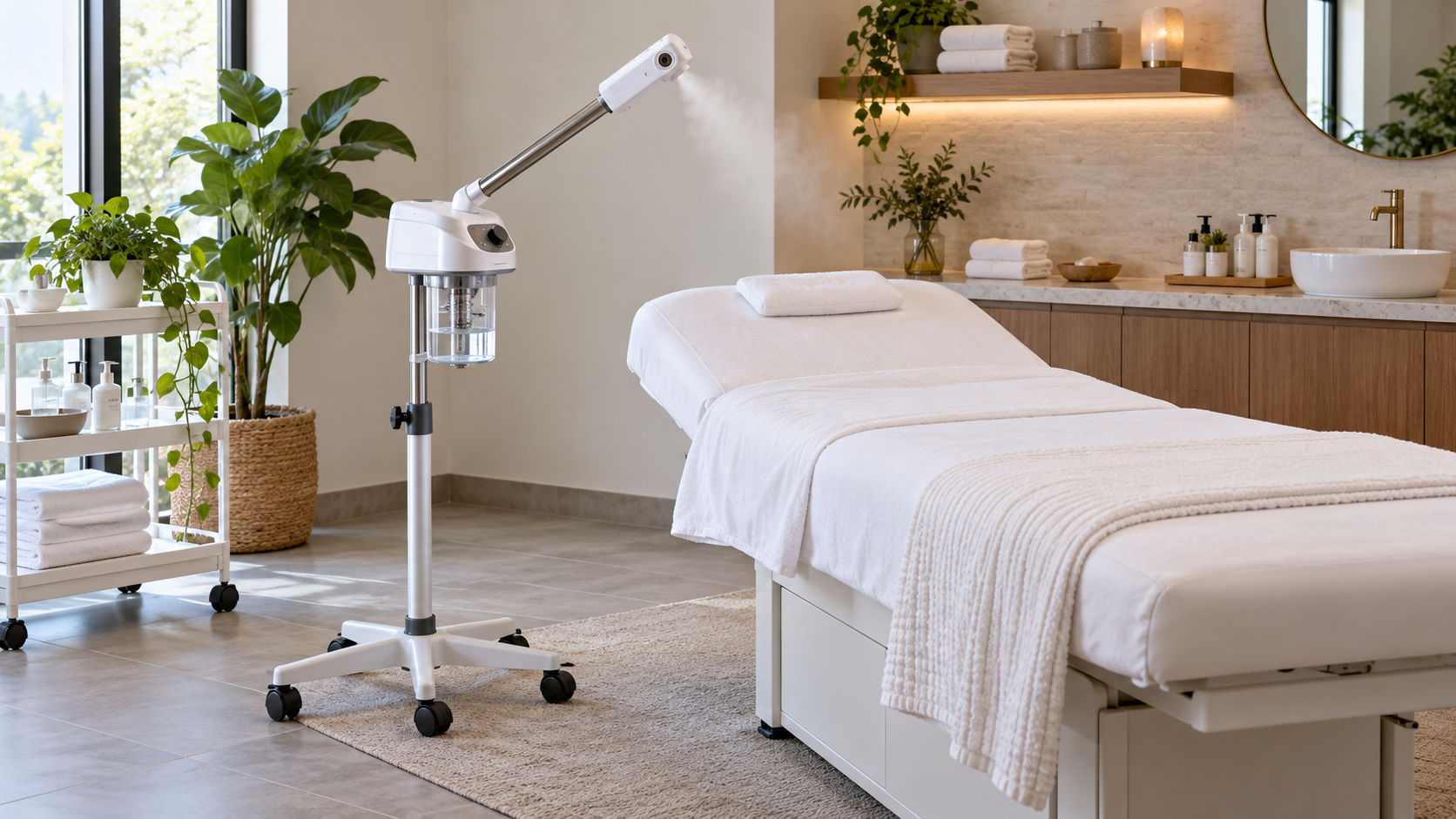
A facial steamer should fit the way your spa works. Beyond producing steam, it needs to sit comfortably beside your treatment bed, offer straightforward controls, and support a cleaning routine your team can follow between appointments. Choosing by price alone can leave you with equipment that interrupts services or takes up more space than expected.
For spa owners and estheticians, the buying decision starts with practical questions. How frequently will you use the machine? Will it stay in one treatment room? Do you already own a magnifying lamp, or would a combined unit make sense?
Discount Spa Equipment offers equipment and furniture for spas, med spas, and salons. This guide explains how to compare professional facial steamers according to your treatment menu, available space, maintenance needs, and budget.
Match Your Facial Steamer to Your Treatment Menu
Start by identifying where steaming belongs in your services. A spa offering occasional cleansing facials may have different equipment needs from an esthetician performing several suitable facial treatments throughout the day.
Cleveland Clinic explains that steam can soften the skin and loosen oil and buildup before blackhead extraction. This supports its role as a preparation step within an appropriate facial, rather than a stand-alone solution for every skin concern.
Before comparing models, consider:
- How many appointments may involve steaming each day.
- Whether several practitioners will share the equipment.
- How much time you allow for setup and cleaning.
- Whether you need a dedicated steamer or additional facial equipment.
- Where the unit will be stored when it is not in use.
Build your purchase around services you already provide or have a clear plan to introduce. Paying for extra functions that rarely leave the control panel adds expense without necessarily improving your workflow.
Choose a Format That Fits Your Treatment Room
The right professional facial steamer needs to work within your room layout. Measure the available floor space, the height of your treatment bed, and the route between your storage area and treatment position.
A floor-standing unit may suit a permanent facial room, particularly when its adjustable arm can reach the treatment area without placing the base in your working path. Check the base dimensions, wheel design, height range, and arm movement before ordering.
A compact tabletop model may be worth considering where storage is limited. However, it still needs a stable surface that supports its weight and allows safe positioning. A small machine is not automatically suitable for a crowded trolley.
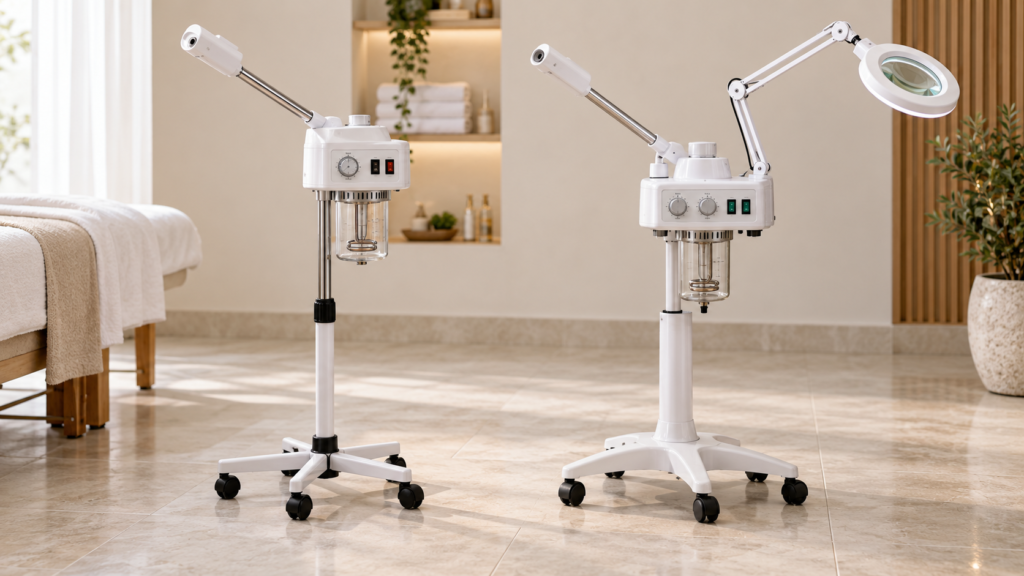
Combined units can bring several tools into one workstation. Discount Spa Equipment lists steamers with magnifying lamps and models incorporating additional facial functions, offering different configurations to compare against your existing equipment.
Think through where your stool, trolley, lamp, and power cord will sit during a complete treatment. The steamer should fit that arrangement without forcing you to reach awkwardly or move furniture repeatedly.
Check Steam Output, Water Capacity, and Controls
Product photographs cannot tell you how a steamer behaves during a working day. Request the operating manual or detailed specifications before purchasing.
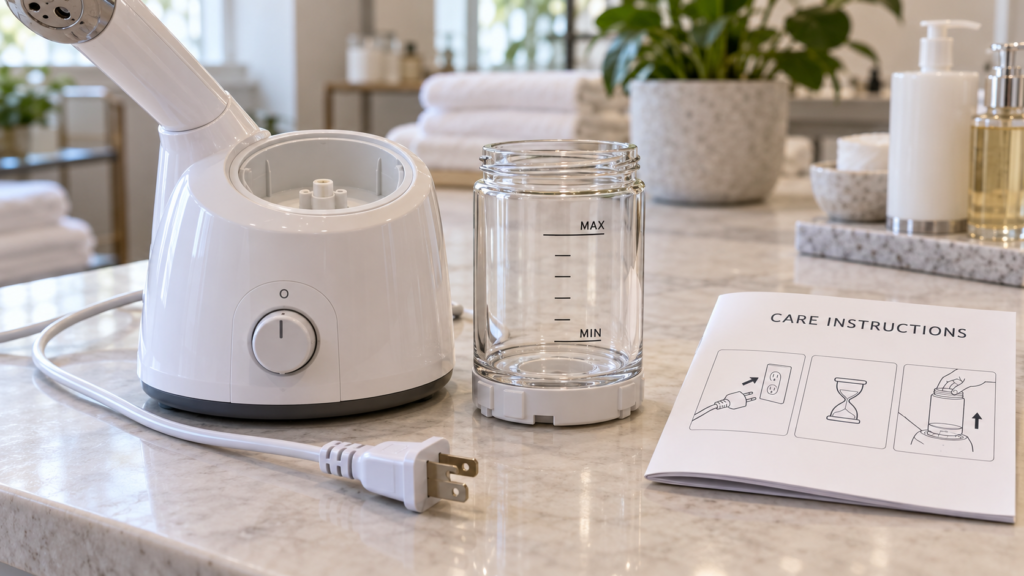
Ask about warm-up time, water capacity, expected operating time per fill, and any required rest periods between uses. A larger reservoir may reduce refilling, but its usefulness depends on the machine’s actual operating instructions and your appointment schedule.
Distinguish adjustable steam output from an adjustable arm. One changes the machine’s output; the other changes its positioning. A product description mentioning “adjustability” may refer only to height or direction.
Useful questions include:
- Does the unit provide adjustable steam output?
- Is there a clearly visible water-level indicator?
- Does the timer stop steam production or only sound an alert?
- What happens when the water level becomes too low?
- How must the unit cool before refilling?
- Are the controls accessible from the practitioner’s position?
A timer can help staff manage a treatment step, but it does not replace observation. Choose controls that are easy to understand and explain to everyone who will use the equipment.
Prioritize Safety Features and Client Suitability
Look for documented safety features, including low-water protection and overheating protection where available. Confirm what each feature actually does rather than assuming that “automatic shutoff” covers every operating condition.
For a U.S. spa, verify the voltage, frequency, plug type, and electrical requirements of the exact model. If a listing claims third-party electrical certification, request details that identify the specific equipment covered.
Client suitability matters just as much as equipment design. The American Academy of Dermatology identifies heat as a potential rosacea trigger and recommends avoiding overheating. That makes heat sensitivity an important consideration before adding steam to a facial.
Cleveland Clinic also advises caution with facial steaming for people with sensitive skin, rosacea, or eczema. A professional steamer should therefore support an individualized service, not become a mandatory step for every client.
Follow the manufacturer’s positioning and operating instructions, assess the client’s suitability, and monitor comfort throughout use. Avoid adopting one universal distance or duration for every machine and every person.
Review Water Requirements and Cleaning Instructions
Maintenance should influence your buying decision before the equipment arrives. Request written instructions covering the reservoir, steam outlet, exterior surfaces, and any removable components.
Do not assume all professional facial steamers require the same water. Follow the exact model’s instructions, including any restrictions concerning distilled, filtered, or tap water. If the listing and manual disagree, ask the supplier to resolve the discrepancy before use.
Check how easily staff can reach and inspect the reservoir. A design that makes routine care awkward can add work between appointments.
Before ordering, confirm:
- The approved water type.
- Instructions for emptying and drying the reservoir.
- Whether descaling is required and which method is approved.
- Which cleaning products are compatible with the equipment.
- Whether replacement jars, seals, or other service parts are available.
Do not add oils, fragrances, herbs, or cleaning chemicals to the water unless the manufacturer explicitly permits them. A model with an aromatherapy feature may use a separate compartment rather than accept additives in its reservoir.
Decide Whether Extra Features Are Worth Paying For
A longer feature list does not automatically make a steamer a better purchase. Evaluate each addition against an actual treatment or workspace need.
An integrated magnifying lamp may be useful if you are furnishing a new room. If you already have a suitable lamp, a dedicated steamer may avoid unnecessary duplication.
Digital controls may make settings easier to read, while a simple control layout may suit a team that wants straightforward operation. Check usability rather than assuming one format is always better.
Some models advertise ozone, aromatherapy, or hot-and-cold functions. Ask what these features do, how they operate, and what precautions apply. Do not treat a feature name as proof of better clinical results or a substitute for cleaning and infection-control procedures.
For combined equipment, also ask what happens if one component needs repair. If servicing requires sending away the whole unit, several tools could become unavailable at once. Separate machines may offer more flexibility, while a combined unit may better suit limited space.
Compare the Total Cost of Ownership
The purchase price is only one part of the cost of a facial steamer for your spa. Compare the full delivered cost and the practical expense of keeping the equipment usable.
Review shipping charges, assembly requirements, warranty terms, replacement parts, maintenance supplies, and any return fees. Confirm which items are included rather than relying on accessories shown in a photograph.
Warranty questions should be specific:
- What components are covered?
- Are labor and return shipping included?
- Who handles troubleshooting?
- What maintenance records are required?
- Are replacement parts available separately?
Consider downtime as well. An inexpensive unit may be less attractive if a minor broken component cannot be replaced. Conversely, a higher-priced model may add little value if its extra functions do not support your services.
Compare two or three suitable options against the same checklist. This makes it easier to identify meaningful differences without being distracted by promotional language.
Choose a Facial Steamer That Supports Your Spa
The right professional facial steamer should fit your treatment menu, room layout, and daily maintenance routine. Prioritize clear operating instructions, appropriate safety features, manageable cleaning requirements, and support for the exact model you choose.
Before purchasing, measure your space and write down your essential requirements. Then compare equipment against those needs instead of choosing solely by price or the number of advertised functions.
Explore the professional facial steamer selection at Discount Spa Equipment. Contact the team to confirm specifications, care requirements, and product suitability so you can select equipment that works for your spa’s available space and planned services.


